A History of 44 (Rhodesia) Squadron
The following short history is from a Rhodesian perspective, published under the Authority of the Air Officer Commanding the Rhodesia Air Training Group in February 1945. Some facts may not have been available to the author at that time, which could account for the odd discrepancy when measured against Squadron historical accounts available today. The extract from the book Rhodesia and the RAF was submitted by Walter Downes.

This Squadron did not become Rhodesian in character until after August 1941, when it was informed that, as soon as the majority of the members were Rhodesian, it would be renamed No. 44 (Rhodesia) Squadron. It was the Squadron in which Squadron Leaders Learoyd and Nettleton, both VCs, served with the rank of Wing Commander as Commanding Officers for a time, and it took part in the devastating attack by ninety four Lancasters on Le Creusot in October 1942.
At the beginning of the war it was stationed at Waddington, under the command of Wing Commander J N Boothman AFC, of Schneider Trophy fame, and was equipped with Hampdens. The station, Waddington, was at that time commanded by Group Captain L H Cockey, who later became Senior Air Staff Officer in the Rhodesian Air Training Group. For many months the Squadron was engaged in leaflet raids, security patrols and mine-laying over the enemy coasts in the North Sea, and it also assisted in delaying the Germans in their drive through France early in 1940. Later it became almost entirely concerned with strategic bombing, including the bombing of the Von Tirpitz, the Scharnhorst and the Gneisenau. In the middle of the ‘blitz’ of British towns, it digressed from its normal activities to destroy enemy aircraft and disorganise raids on such towns as Birmingham and Bristol.
In January, 1941, the Squadron was honoured with a visit by Their Majesties the King and Queen, who held an investiture and decorated officers and men from this and other squadrons. Wing Commander D W Reid was in command at this time.
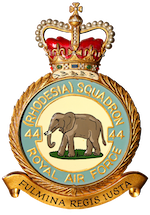
In August, the first Rhodesian-trained pilots posted to the Squadron went on their first operations and bombed docks and shipping at Calais effectively. The High Commissioner for Southern Rhodesia visited the Squadron during the same month and in September it became No. 44 (Rhodesia) Squadron, a Lancaster being delivered to it for training purposes, and further Lancasters in December. In November, His Majesty the King graciously approved the crest, which is described as “On a Mount an Elephant” with the motto Fulmina Regis Iusta.
In December, Colonel the Hon E Lucas Guest, Minister for Air of Southern Rhodesia, and Air Vice-Marshal C W Meredith CBE AFC, Air Officer Commanding the Rhodesian Air Training Group, visited the Squadron. In February 1942, Wing Commander R A B Learoyd VC, then commanding the Squadron, broadcast a description of the Squadron's activities to Southern Rhodesia from the BBC in London.
In March 1942, Lancasters of the Squadron laid mines in enemy waters, this being the first time that these aircraft were used in any operations, and later they bombed Essen, the first time that such aircraft had been used in a bombing operation.
It is noteworthy that Rhodesian squadrons were the first to use two of the most outstanding aircraft of the war, the Typhoon and the Lancaster. In April, the famous raid on Augsburg took place, from which Squadron Leader Nettleton's Lancaster was the only one to return out of eight (sic) which took off. For their part in this raid Squadron Leader Nettleton was awarded the Victoria Cross and three Rhodesians the DFC and the DFM (sic). Shortly afterwards, the Tirpitz was bombed in Trondheim Fjord, and. Rostock and Warne Munde were attacked, the first wholly Rhodesian crew to operate being posted ‘missing’ in the latter raid. At this time the Squadron had been operating with good effect several times over enemy territory and great personal interest in its work was taken by the Prime Minister and the AOC-in-Chief of Bomber Command and, although it lost some of its most experienced crews, it carried on and in May assisted the first 1,000 bomber raid on Cologne, a raid which was a complete success. This was followed almost immediately by another 1,000 bomber raid on Essen, and the Squadron then continued for many months to bomb the industrial towns of Germany, sometimes at great heights and sometimes below 100 feet.
Another great raid was that on the Schneider Works, at Le Creusot in October, in which ninety-four Lancasters took part, including several from No. 44 Squadron. The Squadron kept on punching, and five nights later attacked Genoa with great success.
Two nights after this, they attacked Milan and later, on two successive nights, went for Genoa again. The Fiat Works at Turin were attacked and then the Squadron turned its attention to Germany again and went to Stuttgart, back to Turin, back again to Mannheim, then again Turin and back to Nienberg, Duisburg, Munich and Essen. In the words of one pilot after a raid, the Squadron "made a general nuisance of themselves."
In between their major bombing raids the Lancasters were busy laying mines in enemy waters. This was a form of operation which, although not attracting much attention from the public, helped in no small degree to dislocate the enemy's coastal traffic. From time to time they also dropped leaflets over enemy occupied countries, and here again, although the work was not particularly interesting and immediate results could not be seen, the effect on morale must have been very pronounced.
No. 44 Squadron was never completely Rhodesian, although there was always a large number of Rhodesians in it, but there were many RAF, Canadian, Australian and New Zealand airmen in the crews, and this mixing of the Dominions provided healthy competition between them. They were always out to improve on their previous performances in raids and, in spite of enemy opposition, cold and discomfort, would carry on to the target and drop their bombs, regardless of the tact that they still had several hours of flying to do over enemy country before they reached home, and that, even when they reached England the ground might be, and often was, covered in mist or fog. One aircraft in which a newspaper correspondent was flying was struck by flak which injured the pilot in the right arm, but he completed the mission and returned home safely. Another aircraft struck a seagull which broke the Perspex in the bomb-aimer's position and allowed an icy wind to blow through the fuselage, causing frostbite to some of the crew. A member of the crew removed his glove for a moment and, touching a metal part of the aircraft found that his fingers stuck to it through freezing. In spite of these troubles, the crews' reports on their return would be laconic in the extreme, and they would make such remarks as : "Quite a good show”, “trip O.K”, "very successful trip," “successful sortie - uneventful."
In May 1943, the Squadron moved from Waddington to Dunholme Lodge, carrying on bombing raids on German industrial towns, and in July they were visited by Air Vice-Marshal Meredith and Wing Commander Davison, who talked to the Rhodesians. In the same month Wing Commander Nettleton, who had commanded the squadron for some months, was reported missing after a raid on Turin, and his place was taken by Wing Commander E. A. Williamson, but shortly afterwards he also was reported missing. Then, in August, Wing Commander R L Bowes, who had previously been employed on instructional duties in the Rhodesian Air Training Group, took over command. Wing Commander Bowes, who was awarded the DFC while in command of the Squadron, left in February 1944, and Wing Commander F W Thompson DFC AFC, a Rhodesian, took his place. Other officers who had ably commanded the Squadron for various periods were Wing Commanders Misselbrook and Smales.
Until the end of March, 1944, the Squadron continued with its valuable work of destroying Germany's war industries. Frankfurt, Stuttgart, Mannheim, Wuppertal and many other towns, including Bertin itself, all felt the weight of the Squadrons ‘cookies’ and photographs have since shown that the damage inflicted has been immense.
The foregoing short account of the work of the Rhodesian squadrons gives a slight indication of what was done by those Rhodesians who served in the air forces. Some of them had given up their spare time before the war to learn to fly, some had rushed to join up at the beginning of the war and some, who were still at school at that time, learnt to become service pilots in the Rhodesian Air Training Group. They were the men who left their country to serve elsewhere. While they were away, a large number of men of the RAF entered the Colony and engaged upon the somewhat duller but equally important business of training further aircrews, as will be seen in the next chapter.