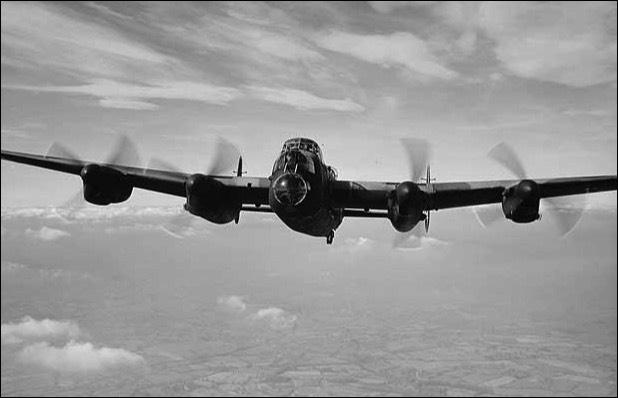
Our crew had been together for 25 ops. Six of us: F/Sgt Dudley Ibbotson, the skipper; F/Sgt Ian Murray, the bomb aimer; Flt Sgt Ted Greatz, the navigator; Sgt Frank Wells, rear gunner; Sgt Tom Whithand, mid-upper gunner and myself had crewed up at No 28 OTU Wymeswold and Sgt Ray Worral, Flt Eng, had joined us at No 1661 Conversion Unit at Winthorpe.
On the 25th July we received word that , for the second night in succession, ops were on again and we went about our various tasks for the daily inspection of our Lancaster ‘L’. The weather was perfect and tonight would be our 26th op. After my briefing in the Signals Office, together with the gunners Frank and Tom, we strolled across to the Main Briefing Room to join the rest of the crew. There speculation was running high, only to be cut short when the Station Commander removed the covers. A murmur of disbelief swept the crowded room: Stuttgart again, along a route that, to our amazement, appeared identical with that of the previous night. Then the Squadron had returned without loss but the Main Force had suffered heavily in a string of combats.
With briefing over, we removed ourselves to the crew locker rooms, turned out our pockets and stowed our personal gear. I even left my cigarettes behind! The collection of escape kits and parachutes was accompanied by some of the usual quips: “If this ‘chute doesn’t work I will be back to haunt you.” and “If it does work I’ll be back to kiss you.” I never did manage the latter.
With another crew we piled onboard the old Dodge crew van and set out for Dispersal, where we were first out. A voice came wafting out from the interior and bade us farewell. Instead of the usual “Save me some eggs and bacon, we may be late” it said “Hope we don’t see you tomorrow.” To this day I can still hear it.
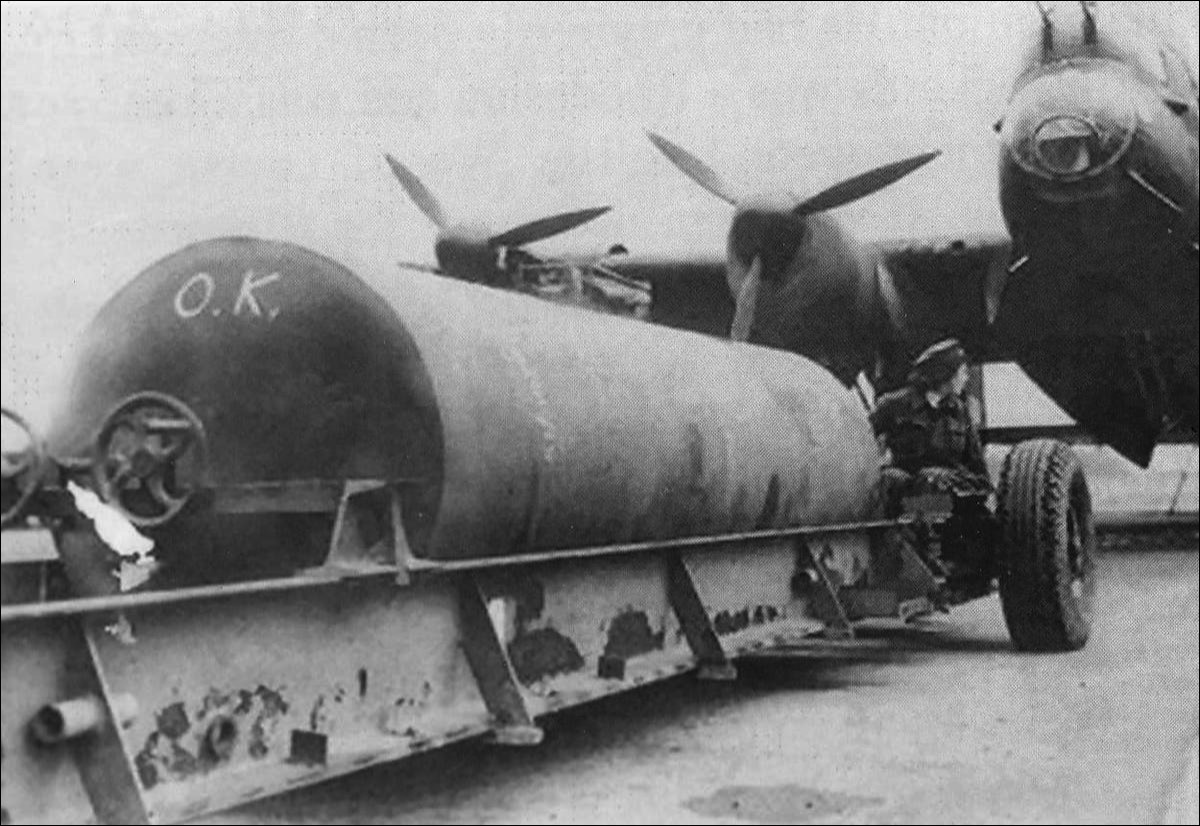
A 4000lb ‘Cookie’ about to be loaded onto a Lancaster.
Before long, take off was past and all checks were OK and with the 4,000 lb ‘Cookie’ and 30lb incendiaries safely in the bomb bay we thundered towards the target. On leaving the English coast the gunners checked their guns and I turned off the intercom and concentrated on ‘Fishpond’, an offshoot of H2S. Although a lot of Wireless Ops on the Squadron were not too reliant on it, we had been quite successful in detecting enemy aircraft with Fishpond. I think it was a matter of cooperation between the pilot, navigator and WOP. Dud Ibbotson, our pilot, made sure he pivoted the wings up and down 10 degrees to give Fishpond a much better coverage of the sky, enabling me to locate any fast-moving blips and pass the information to the gunners.
We droned on for what seemed like hours and as I was being hypnotised by the screen, decided to turn on the intercom for a break. I switched over to hear combat reports from the crew: the Bomb Aimer, Ian Murray, was telling of a plane on fire on the ground to port; the Rear Gunner reported a combat on the port side. I opened up my cover to see a sky bright with burning aircraft and promptly turned off the intercom and returned to Fishpond.
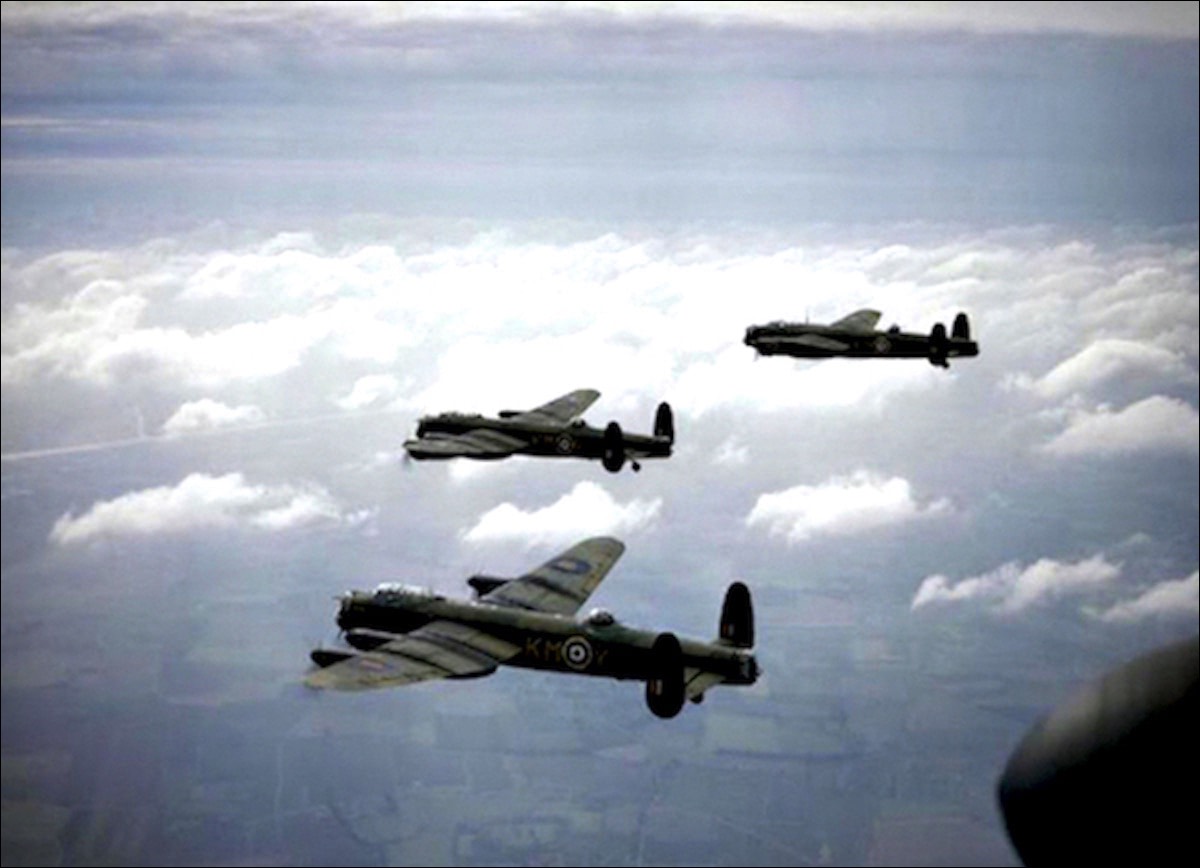
A section of three Lancasters en route.
The next thing I heard, or felt, was a large thump from the rear and the aircraft climbing. Switching back to intercom I heard the skipper order the crew to bale out. It turned out that an aircraft on fire directly above us had jettisoned its bombs, one of which had taken off our tail fin. I had been well indoctrinated for bale out: destroy the code of the day by eating the rice paper, put the rest of the Sigs papers on the floor beside the main spar and put the Very cartridges on top of them. I checked the H2S and detonated the charges. Jamming the parachute onto my chest, I tried to leave my seat, only to find that my flexible oxygen hose was caught under the ‘chute. I whipped off one side of the ‘chute, pulled off my flying helmet and mask and put the ‘chute back into position. By this time I could tell the aircraft was diving and decided to take the quick way out via the escape hatch in the bomb aimer’s compartment. That was fortuitous for I passed the pilot’s position to see Dud pulling back on the column as hard as possible and then noticed that his ‘chute was only clipped on to one side of his chest. I stopped to rectify this only to be told in no uncertain terms to **** off. From sitting on the escape hatch and bending forward I have no more memories until that of laying with my back against a giant stook of wheat with my ‘chute draped behind me and a recollection of ammunition exploding and our aircraft burning in the distance.
I learnt later from Dud that I had left the aircraft at 1,000 ft. He had dived out straight after me, estimating that he came out at approximately 800 ft. His ‘chute opened, did one oscillation then he hit the ground. My mind was not functioning too well and I had no idea where I was, other than it had to be somewhere in France. Gathering up my ‘chute, I hid it under a stook of corn and then crawled out of sight under another. I must have been semi-conscious because it seemed no time before I could hear the Main Force overhead on their way back to bacon and eggs.
I dozed on and off until a sound something like an iron drum being rolled down the road barely 150 ft away brought me sharply to my senses. The noise stopped and then came towards me much quieter. I peeped out to see a steel-wheeled harvester beginning its first cut of the day, which, since my stook was right next to the uncut wheat, was bringing him perilously close. Was he a friend? I did not take a chance and stayed put, chewing nervously on the same piece of gum that I had popped into my mouth during the night. Twice during that day a lorry with German soldiers perched on the mudguards drove slowly down the road, obviously looking for evaders. Around 6 pm the reaper with his horse and harvester disappeared up the road and after a short interval I decided to get moving. Rising from my cramped position, I could see a small house on the road about two hundred yards away, with a larger house in the distance. I had already cut the tops off my black flying boots with the knife supplied and removed both my Sergeant’s stripes and Air Gunner’s brevet. In addition, my uniform was pretty dusty from laying in the dirt all day so I thought that, at a pinch, I might escape notice.
I made for the small house and as I approached, a dog started to bark. I kept walking, only to hear a boyish voice behind me say “Bon camarade, RAF.” - so much for my disguise!
The lad led me into the backyard and introduced me to his mother and sister, who gave me a cigarette and a glass of clear liquid: Calvados. The combined effects of the drink, the cigarette and the lack of food were like the kick of a mule, making me groggy for quite a few minutes, such that I was taken inside the house. There I tried to converse with the young girl but her French did not match my English; but then, courtesy of a piece of paper, we were able to make ourselves understood. I found out that the family was Dutch and their father, who had been in the Imperial Dutch Guards, was not a prisoner in Germany. I also discovered, to my horror, that not only was the larger house a German HQ, or Officers’ Mess, but this small house was its lodge. I immediately told my new friends that I would depart as soon as possible but they informed me that they had already sent for the local `padre and asked me if I would like to eat whilst I was waiting. In the excitement of finding friends, I had forgotten just how hungry I really was and made short time in consuming a plate full of bacon, eggs and bread.
When the Padre arrived he explained about the very great number of Germans in the area and made no bones about telling me that I could neither stay in this house nor anywhere in the village. I was not very happy with his attitude, but on reflection, he was doing the best thing for his flock for had I been caught I would simply have been taken as a POW, whereas any parishioner who had helped me, faced death.
Fortified with some provisions, they gave me the general directions to reach the Second Front in Normandy and I left the lodge heading away from the
village, but in the general direction I wanted to go. The time was about 2100 hrs and still light. Eventually I decided to hide for the night' and chose a copse in a field of uncut oats that were as tall, if not taller, than I was. I made my way towards the clump of trees in the middle, trying to cover my route through the oats, yet having to jump up every few yards to see if I was still going in the right direction. The trees gave good cover; there was room to lay down and I would be able to hear anyone approaching through the oats. I laid down on my back but after a while had to cover up my face with my silk map and put my hands in my trouser pockets to keep off the mossies that seemed to be attacking in squadrons.
It was light when I woke and I could hardly move for I was so stiff, even getting my hands out of my pockets was quite a job. For breakfast I chewed on a couple of bits of bread that my Dutch friends had given me and worked on a plan of action: to head in the direction of Normandy by day and sleep up at night. The next few days are hazy memories of walking and eating anything I could find: raw potatoes, turnips and anything that was edible. Eventually I became fed up with this and decided to took for he[p. I had been on the run four nights and the following morning I spotted in the distance a group of farm buildings. As I got closer I could see that it was indeed a cluster of houses, not a village but a farming community and I made for the only person I could see, an old man. I produced my English/French card and pointed out the phrase that said "Are there any Germans here?" whereupon he gripped my arm and lead me towards the biggest house.
For one moment I wondered if I had done the right thing. Was this another German HQ? If so it was well camouflaged, for I could see no sign of German occupation. By the time this had registered we were at the door, and answering the old man's knock, there stood a pleasant middle-aged lady in a dressing gown. She promptly grabbed my arm and hustled me inside very quickly. After a few questions, she sat me down to breakfast. Then I was taken to a bedroom and told to undress, get into bed and stay there. My clothes were taken away, presumably to be washed and I was soon well asleep. My slumbers were, however, rudely awakened by someone else climbing into bed. It turned out to be a New Zealander who had been shot down the night before and after introductions we talked and slept.
We were allowed to get up for the evening meal and I was given some old clothes to wear. The lady was the farmer's wife; we then met her husband who, speaking in french while his wife translated, laid down the law to us: we were not to leave the house until all the farmhands had gone to work on the harvest, then it was only to go to the outhouse (‘dunny’). That night we were told, visitors would be coming but we were not to open our mouths. Later in the evening a knock sounded on the door and a file of men came in. They went to a cupboard in the kitchen, removed a panel in the back, took a Sten gun or carbine each and then disappeared out of the back door. Our farmer was the leader of the local Resistance. We did hear firing later in the night but did not know if it was related to visitors or not. Later in the night from the bedroom I heard noises as the guns were replaced. At breakfast with the family nothing was said about these events, nor did we ask any questions.
After the farmer had gone to work we were shown a large shortwave radio inside another cupboard, and told that we could switch it on at certain times to listen to the BBC. news. This was great, even if we did have to strain our ears to hear it.
The next day we were told to expect a visit from an RAF officer, who would like to talk to us and we waited intrepidly. About 1000 hrs two visitors arrived on bicycles, both looking just like the farm workers we had seen from the windows of the farmhouse. The leader, a Belgian who I believe was Baron Jean de Blommaert, asked many questions. Then having decided that we were genuine, told us that a camp had been organised in the Forest de Fretaval to accommodate evaders no longer able to pass along the Comete escape line to Southern France. After our escape to England we found out that this and another camp, had been the brainchild of Airey Neave of Ml9. Our new[y acquired Belgian friend told us to stay while he interviewed a few more evaders in the district and then he would come back for us. It was great to think that soon we might be seeing other members of our crews again. Shortly after lunch he returned alone. Taking our uniforms and putting them in a sack he told us to follow him at a distance. We said goodbye to our French hosts with a hug and a kiss, and set out keeping some two hundred yards behind our leader. After a few miles we met up with his companion who was also accompanied by about four nondescript blokes. We were not introduced but I was disappointed not to see any of my crew amongst them. The leader, with the first group about two hundred yards behind him, set up a faily sharp pace while we positioned ourselves a further two hundred yards behind them. We walked in the beautiful August weather throughout the afternoon and most of the evening and did not see any of the enemy. It could have been a different world.
Finally we reached the Forest of Fretaval and, as we walked up a cart track into the wood, were greeted by a well-hidden airman sentry. Armed with a whistle and nothing else, he and the other sentries posted at each pathway into the forest, were to blow the whistle long and loud if the Germans made any large penetration of the forest.
Continuing along a narrow pathway, we eventually arrived at the camp, situated in a small clearing where the first person I spotted was Dud Ibbotson, my skipper. After a great reunion Dud told me the welcome news that both the Navigator, Ted, and Bomb-aimer, lan, and Engineer, Ray, were also there. Nothing had been heard about either Frank (Rear-gunner) or Tom (Mid-upper gunner) and we remained concerned.
I slept like a log that night and the next day was introduced to our tent, made out of camouflaged groundsheets with a wire netting frame and straw to sleep on. Dud, who had landed close to the woods, had kept his chute and we used this to cover us at night. For our crew the order of the day was that we slept with our shoes and clothes on in case we had to beat a hasty retreat. At night we started steeping head to toe, but after a while the wafting of cheesy feet grew too much and we resumed a normal sleeping position. During the day we took off our main clothes, shoes and socks for airing. I was introduced to the camp routine, which was well organised to keep us busy. So many hours on sentry duty, a period each day on kitchen party (K), the rest of the time we spent sunbathing and whittling wood. We kept our tents well camouflaged with freshly cut tree branches and the old iron fireplace we had was fed with charcoal to cut down smoke that may have given us away to an Ack Ack site in the vicinity. In a clump of trees 20 feet from the edge of the forest there was a natural spring where we obtained all our water.
The day after I arrived in the Forest I was summoned for an interview with the Big Chief, apparently a Wing Commander in the RAF, and therefore the Senior Officer i/c the camp. He introduced himself as 'Cousin Lucien’ and after asking me the usual questions he told me that my name would be conveyed to the Air Ministry, presumably for checking. I was told not to leave the camp under any pretext unless he ordered it by an order given to everyone in the camp, as a matter of security for the whole organised set up.
I learned after the war that Cousin Lucien was really Wing Commander Lucien Boussa, a Belgian in the RAF who had won a DFC in the Battle of Britain. He, and a wireless operator named Toussaint, had travelled overland from Spain to take charge of our camp and its splinter camp some six miles away.
Life in the camp was not dull. Food was scarce but Cousin Lucien and De Blommaert combed the local farms for black market food, for which they paid well, using funds supplied by Ml9 in England. Although we did not starve, we were always hungry. A typical day’s rations per person were: breakfast - two pieces of black bread sprinkled with sugar; lunch - a plate of boiled French beans; supper - two pieces of black bread and a mug of coffee made from ground baked barley (no milk). Sometimes our rations were supplemented by a leg of veal or fresh veggies. These were real feast days. There was a great shortage of cigarettes and those we did get were French and very strong. At one time I tried smoking the moss from the side of the trees using Rizla cigarette papers, which the Navigator, Ted, had in abundance, but we soon gave that away because of the coughing fits we had.
After a week or so we heard that an injured gunner was coming into the camp and kept our fingers crossed. Sure enough, it was our Rear Gunner, Frank Wells, who had been held at a resistance camp to explain the works of some of the guns dropped to them by the RAF. Unfortunately, while showing a couple of enthusiastic youngsters how to handle pistols, one of them had shot him in the ankle. Only Tom Whithand, the Mid-Upper Gunner, was still missing.
One night as we lay in our tents one of the sentries came around and in a whisper warned us not to make a sound as some German tanks were close to the edge of the forest. Later in the night we heard a tank enter the forest close by and we hardly dared breathe, as the sound of repairs coupled with German voices penetrated our tent. Luckily they finished their work on the tank and moved off into the night and we breathed a little easier as we realised our vulnerability.
Feedback from Cousin Lucien told us that the Allies were getting close and we could expect rescue at anytime. Later we learned that both the chiefs went to see Airey Neave at Le Mans, urging him and the SAS to effect a rescue as soon as possible. Unfortunately Airey was bogged down trying to get transport to bring us out. While they were away, a message was sent to the camp from Cloyes that the Gestapo were there in force and it was agreed among us to scatter to the four winds. Our crew kept together and decided to get food at the nearest village. We entered a wine shop, sat down and before long were in conversation with a girt who spoke quite good English and kept us supplied with red wine There was no food in the shop but she left and soon returned with a basket full of eggs, which she cooked and we ate very smartly. As the hour was late we decided to look for somewhere to sleep. In our meanderings we came across another village where we managed to buy bread and eggs before finishing up in another wine shop. There the eggs were cooked and we had more wine, this time before an audience of excited Frenchmen and women who kept patting us on the back and plying us with even more wine. Full of food and wine, we finally managed to get through to our friends that our pressing need was for sleep, whereupon a local farmer took us to his barn. There we soon fell asleep in the hay.
Early in the morning we were awakened by the sound of heavy footsteps outside on the cobblestones. We all froze except Dud, who chose that moment to be sick. I am not quite sure what we dld to quieten him but I think we must have pushed his head into the hay. The footsteps by this time had stopped and after a short interval, which seemed like hours, the footsteps moved away and we all breathed a sigh of relief.
Early the next day we departed from the farmer with a firm handshake and set off to return to the camp. As we walked along the road we heard a motorcycle approaching from behind. We edged into single file and I sneaked a look backwards to see in the dawn light what looked like a soldier wearing a German helmet riding towards us. I quickly turned my head down and looked at the ground ahead. As the rider slowed down beside us I thought "This is it. The tension broke when a voice said "Any of you bastards speak English?” in an American drawl. The relief was tremendous and as we crowded him for news I am not sure who was the more surprised.
He told us that a light armoured jeep, out on reconnaissance, had met a bunch of our boys and radioed back for an armoured convoy which was now on its way to the camp. We raced back arriving just in time to pick up the Skipper’s parachute and climb onboard the last truck. Escorted by armed jeeps and M 20 armoured cars we set out for Bayeux, but our trials and tribulations from friend and foe alike were not yet over. Between the forest and Cloyes we passed a convoy of buses all decked out with Free French insignia and French flags: Airey Neave's rescue bid, continued to the two forest camps and rescued the majority of the stragglers over the next 2 hours. Meanwhile we continued toward Le Mans. In the evening tight we suddenly stopped and were told by our drivers to keep our heads down as a suspicious car was parked beside the road with lights on. A couple of soldiers were despatched forward and a couple of moments later rolled grenades underneath it. After the explosion we continued on our way, not knowing the result. That night we camped in a field with real armed guards around us. Next day we reached Le Mans, which had recently been liberated and were billeted in a former German barracks. The following day we were joined by the rest of the evaders who had been rescued by Airey Neave and his crew of SAS and Free French. We all boarded a convoy of trucks with a motorcycle escort and sped off through enemy territory heading for Laval. Negotiating a sharp left hand bend, the truck behind us swerved to avoid a small child and turned over onto its side, spilling the evaders all over the road. It took some time to get all the wounded bandaged up and sorted out. While the badly injured were taken by the local French people into their homes to await the local doctor, the rest were placed aboard the other trucks and we took off in haste to get clear before any Germans turned up to investigate.
That evening we arrived at Laval and the convoy drove into the city square where liberation festivities were in full swing. Within seconds our trucks were surrounded and it became obvious that the people of Laval thought we were German prisoners. The thought flashed through my mind ‘fancy getting this far only to be lynched by our friends’ for our drivers, armed only with sub-machine guns were helpless in keeping the crowds away from the trucks. With a flash of inspiration, someone on our truck pulled out his dog tags and we began chanting “RAF, RAF ―". Immediately the ugly mood changed and we were plied with champagne and cigarettes. From Laval we journeyed on through the evening towards Bayeux, pulling up short of the Falaise Gap at an American POW camp. There we bedded for the night armed with carbines to defend ourselves in the event of a breakout. The next day we passed through the Falaise Gap with all its wrecked machines, dead animals and bloated human corpses smelling in the August sun. It was a sight I never wish to see again. At Bayeux we deloused, debriefed and kitted out in army battledress. After a few days leave we were flown home for interrogation and more leave.
Nearly all the 152 or so airmen saved from the forest returned to ops, serving in a variety of theatres. Thirty eight were subsequently killed in action. I was one of the lucky ones, surviving a further 103 ops with No 194 Sqn in Burma in 1945. Our Mid-Upper Gunner, F/Sgt Tom Whithand, stayed in France. He lies in the cemetery at St Germaln. We still do not know what happened to him - we still do not forget him.