A Trip to Australia
by Jim Gardiner (44 Sqn 1972 - 1974)
In 1973 the Squadron detached on the westabout route to RAAF Darwin in the Northern Territories of Australia. There were four aircraft in the plan and we took off in thirty-minute intervals; both extra seats were fitted in the rear compartment and each aircraft carried five crew plus two crew chiefs. Each bomb bay was fitted with the forward cylindrical tank containing 8,000 lb fuel and a 4000lb capacity pannier. Two of the four panniers contained spares for the detachment and the other two mostly carried booze! We actually carried our return duty free with us plus enough for entertaining along the way. As shown below, we flew two legs each day for the first three days, then one long trip into our destination.
Itinerary
Day 1. Waddington to Goose Bay, Labrador - Goose Bay to Offut AFB, Nebraska. Flight time 9 hrs 5 mins.
Day 2. Offut to McClellan AFB, California - McClellan to Hickham AFB, Hawaii. Flight time 8 hrs 20 mins.
Day 3. Hickham to Wake AFB, Wake Atoll - Wake to Anderson AFB, Guam. flight time 7 hrs 40 mins
Day 4. Anderson to Darwin, Australia. Flight time 5 hrs 25 mins.
My crew were No 4 in the stream and at the time we were out of favour with the Sqn Cdr (explain later) who, not surprisingly, was particularly keen to get all four aircraft to Darwin on time to meet the operational requirement of the exercise. Going unserviceable somewhere exotic could well be frowned upon! Our radar became unserviceable over the Atlantic so we were soon into sun/moon shots, deep joy. We kept it quiet at Goose (first mistake) and snagged it at Offutt, but didn't tell the boss. They ‘fixed’ it but it was unserviceable again before McClellan, so we had no option but carry on to Hickham. Being left behind by the Sqn worried the crew more than the navigation issues posed by having no radar. When approaching Hickham we were directed to the NE runway which crosses the two parallel main runways. Of course, given the limitations of our ILS we did not have the required frequency in that noddy ILS box. The very smart controller sussed us immediately and asked if we could see a C141 ahead. We said yes and he told us to follow it at 160 kts. We could then relax and enjoy the spectacular views of the island. Late on the approach I was quite surprised when a 747 took off on the East runway between the C141's landing and ours. My first experience of a major civilian airfield.
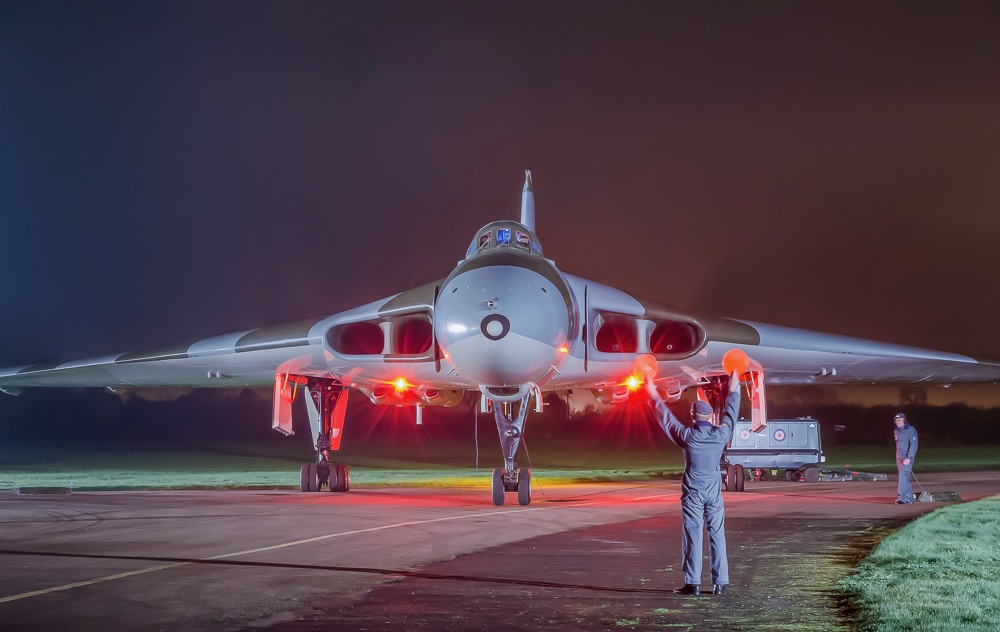
The next day finding Wake Island was going to be bad enough, but we also had to complete the GPI 6 date line change from 180W to 180E, difficult enough when you are sure about your position. All went well and we were very relieved when we made contact with Wake radar. Quick lunch and on to Guam. The Anderson airfield was an amazing sight because it was covered in B52Ds waiting to go home after hostilities in Vietnam had stopped in the August. We had a visit to a B52D and its cockpit looked like a Lancaster. The yanks thought that the Vulcan cockpit was really flash! Just to prove that it is a small world, while rushing to collect the in-flight rations the following morning for our leg to Darwin, in the massive Ops room I bumped into one of my Basic Flying Training Jet Provost instructors. There was a large group of fresh-faced USAF aircrew being briefed by someone that I could not see. But the voice and the forceful delivery could only be Major Proudfit, who had been the USAF exchange QFI at Cranwell. He introduced me to his extended crew who were all students on the C135 OCU.
The next leg to Darwin was very tense and without the radar the navigation team did a great job, but eventually confidence was low. We were heading south towards Darwin and the AEO remarked that we had just passed between two islands, one either side of track, and one much bigger than the other. The plotter said that is good news but how did he know. The AEO had depressed the Red Steer radar as low as it would go and was getting good ground returns. We were close to track but ahead were a line of Cu Nims, which we tried to climb over, but failed. In severe turbulence we reached top of the descent but we could not contact Darwin because of the static on the radios. Eventually we made contact and Darwin ATC tactfully told us that the previous aircraft had approached from further west! As soon as we started a gentle turn we came out of the cloud and could see Australia. The boss was very pleased to see us because he now had four reasonably serviceable aircraft but he was also very unhappy, but not with us for a change. When he in the lead aircraft landed at Darwin, he had been surrounded by TV crews to ask for his comments on the Aboriginal protest to the planned RAF bombing of their ancient burial ground, Quail Island. Group hadn’t warned him and the RAAF seemed to let the media do what they wanted. As it turned out, each day about an hour before we dropped 7x1000lb bombs (inert), the RAAF helicoptered the police out to Quail island who arrested the protesters. Of course they all went back again as soon as they were released!
Unfortunately, the planned detachment of an RAAF Mirage Sqn to Darwin didn't happen as they were held up in Butterworth. In the absence of fighter affiliation we had to make do with ship attacks. Not really something for which the Vulcan was well equipped, but we understood that it would be useful training for the Royal Australian Navy. My crew's first attack was on a Frigate which we had identified on the radar and we planned to overfly, probably not below 300 ft!!!! At about 3 miles with permission to overfly, to our horror the 4.5 inch guns opened up with what we discovered later was break up shot (blanks). It looked very real to us and we broke off the attack! One up for the RAN. We were hosted generously by the Aussies and after two weeks we were quite sad to have to move on to Singapore.
The reason our crew was temporarily unpopular with the boss! Three months before our arrival in Australia, the Sqn had been on a 3-week detachment to Malta (such hard work). With serviceable aircraft and good weather we flew our hours allocation in the first 2 weeks, so had the remaining week free to enjoy ourselves. The ground crew were from Line Sqn because, unlike Scampton, the Waddington Squadrons did not have their own engineers. (The dreaded Line Servicing.) The boss was determined to have a Squadron party despite the officers being against it and the ground crew being downright hostile to the idea. My crew was picked to organise the party! Everything was fixed for an evening boat trip around Malta for about eighty people with food and booze and a three-line whip. The day before the trip was due to happen, the owner of the boat cancelled and gave us our deposit back. The Sqn was delighted and the boss was not happy and we think suspected double dealing. Cut to the arrival party at Darwin when we were all in high spirits. My captain says he is going to have it out with the Boss, that in fact we had nothing to do with the cancelled boat trip! We couldn’t talk him out of it. He wanders over and taps the Boss on the shoulder, who turns and smiles at him. The captain says, “Sir, I was wondering if you want a boat trip round this ****** island.” The boss laughed heartily as did everyone else and the issue was closed. Our crew was subsequently picked for the weekend jolly to Hong Kong. I was left behind but that is another story.
A little known fact. Some time after Rhodesia declared UDI in 1965 it was decided that 44 Sqn should drop the “Rhodesia” from the nameplate. In early 1973 Bob Aspinall was the Adjutant and had to place an order for Sqn headed note paper. Somehow Rhodesia was reinstated and the executives decided to let it run and see what happened. The rest is history.