In Memoriam
Sadly the following members have died since publication of the last newsletter. We extend our sincere condolences to their families and friends.
Simon Baldwin
John Jenkins
Mrs Jean Kendrick
Helge Kristensen
James Power
Hugh Wykes
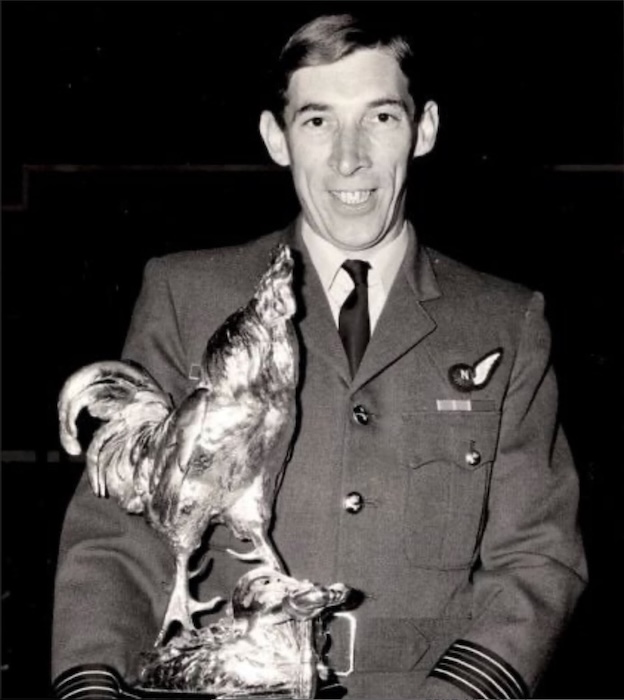
Air Cdre Simon A Baldwin MBE RAF
17.09.1942 - 17.03.2026
Air Commodore Simon Baldwin, was not only an outstanding RAF navigator but he was also the very last boss of 44 Squadron and the much-lamented President of this Association.
Simon was born on 17th September 1942 in Nottingham and attended West Bridgford Grammar School. He excelled at sport - all sport but particularly cricket. Indeed, as a youngster he captained the Nottinghamshire Youth XI and it was touch and go whether he applied for the Royal Air Force or became a professional cricketer. County Cricket’s loss was to prove the RAF’s gain.
After navigator training he joined 45 Squadron flying Canberras at Tengah in Singapore. His tour there coincided with the Indonesian Confrontation. As the most junior navigator on the squadron, he was expected to keep a low profile. However, it was not in Simon’s nature to be a shrinking violet and he ruffled a few feathers on the old and bold but, by steadily achieving better results than anyone else, he gained the respect of his peers.
The V-Force beckoned and on return to the UK, he converted to the Vulcan at RAF Finningley before joining 617 Squadron at RAF Scampton, a squadron equipped with the Blue Steel air-launched, nuclear stand-off missile. The role was less than appealing but much better things lay ahead.
In August 1970 he left for RAF Akrotiri in Cyprus, the home of two Vulcan squadrons, where he served as the Navigation Leader in the Bomber Wing Headquarters. To some, it seemed that this young Flt Lt was running Bomber Wing and he soon found his niche: international bombing competitions. He oversaw NEAFs successful participation in the 1973 event and when he moved back to Scampton on promotion, he was really to make his mark in this competitive field.
In 1974 he was instrumental in the team of four Vulcans achieving the RAF's best results in the annual US Strategic Air Command Bombing and Navigation competition, Exercise Giant Voice, flown from a USAF base in Louisiana. He was responsible for the pre-deployment training of the selected crews, and his expertise in the complexities of the Vulcan's ageing navigation and bombing equipment was pivotal in their success against the more modern and sophisticated systems of the USAF bombers in the competition.
Simon had the knack of identifying and analysing a problem quickly and devising a solution not always apparent to others. Having established the technique to be used, he was singleminded in pursuing it and and famously adept at convincing colleagues and superiors of the validity of his plans. The RAF team won two of the three major trophies, both for the first time after 17 previous attempts. In 1975 he was appointed MBE.
After a series of ground appointments, he returned to the V-Force as commander of 44 (Rhodesia) Squadron in 1980. The UK's strategic nuclear deterrent had passed to the Royal Navy, and Vulcans operated in the low-level conventional bombing and tactical strike roles in support of NATO. The highlight of his tour in command came the following year when his squadron made a clean sweep of the trophies in the annual ‘Double Top’ bombing competition against the other Strike Command squadrons.
Simon’s tenure as CO of the Squadron came to a spectacular climax in April 1982 when Argentinian forces invaded the Falklands. He was tasked with establishing a planning cell to investigate the feasibility of using Vulcans to attack the airfield at Port Stanley, which was being used by the Argentine air force. The overriding issue was the extreme range for any attack, which would have to be mounted from Ascension Island, almost 4,000 miles from the Falklands. In addition, the bombers were configured in the nuclear-strike role of the Cold War era and his crews had no experience of in-flight refuelling, an essential requirement for the mission.
Numerous initiatives had to be implemented: the aircraft had to be re-equipped to carry 21 1,000lb HE bombs; new inertial navigation equipment had to be sourced, fitted and tested to supplement the Vulcan’s ageing NBS kit; extensive work was necessary to reactivate the in-flight refuelling system; the aircraft also had to be modified to carry specialist electronic countermeasures and, on later missions, Shrike anti-radar missiles.
These were tall orders and Simon implemented a concentrated training programme for the selected crews in an exceptionally short time frame. The final trial sortie with the extensively modified aircraft was flown just 12 days after the order to prepare. Two days later, two aircraft deployed to Ascension.
The following day, April 30, Operation Black Buck was mounted when two Vulcans and eleven Victor tankers took off and headed south. The primary Vulcan became unserviceable and the bombing task fell to the reserve crew captained by Flight Lieutenant Martin Withers. The in-flight refuelling plan was the most complex ever mounted at the time, and required tankers to refuel each others in order to sustain the supply to Withers, who would attack the target and return after almost 16 hours in the air.
It was at the time the longest-range bombing mission in history. Simon, the mastermind, remained in the background, but without his skill, perseverance and professionalism the mission would probably not have succeeded. I am reminded of Roland White’s apt observation in his book Vulcan 607: “Simon Baldwin started early and finished late as he concentrated on trying to bring Sir Michael Beetham’s vision to life. As he worked he lived off a diet of bacon sandwiches, coffee and Gold Block pipe tobacco.”
The withdrawal of the Vulcan force from RAF service, begun before the Falklands War, continued afterwards, and Simon presided over the disbandment of 44 (Rhodesia) Squadron on 21 November 1982, the last Vulcan bomber squadron.
Career appointments followed. He served as the personal staff officer to the C-in-C Strike Command, Air Chief Marshal Sir David Craig. It might be considered an overstatement to say Simon Baldwin ran Strike Command. But he built a cabal of the Senior Staff officers at the Command and between them – often in the bar late on a Friday night – made sure that their masters were playing from the same sheet of music. After a successful tour at Strike, he then assumed command of RAF Wyton, the base for the RAF's Nimrod strategic reconnaissance force.
After a Defence Fellowship at the National Defence University in Washington, he became the Air Attaché and Commander of the RAF Staff in Washington. He spent his final three years in the RAF as the UK National Military Representative at the Supreme Headquarters Allied Powers Europe in Brussels, before retiring in 1996.
A member of his squadron recalled that his boss was "a fantastic leader, fine officer and excellent role model for any aircrew officer; his squadron would have followed him anywhere.”
In retirement his pursuits were many and varied. He was the first president of the Waddington Branch of the Royal Air Forces Association, a position he held for 16 years. He then became the enthusiastic and charismatic President of 44 (Rhodesia) Squadron Association, a post he held until his death. In addition to golf, which he played with a single-figure handicap, cricket remained a passion; he was also a strong supporter of Nottingham Rugby Club, and even travelled to South Africa to watch the Lions play. He was fond of traditional jazz and he and Sheila were renowned as excellent hosts at Hill Top Farm.
Simon Baldwin is survived by his wife Sheila and their two sons Stuart and Richard. We are all lucky to have shared part of his life; for Sheila, Richard and Stuart he was their lives and they can be immensely proud of him as he was of them.
Sheila has asked me to convey her gratitude to the many people who lent such valuable support during what was a particularly difficult time.
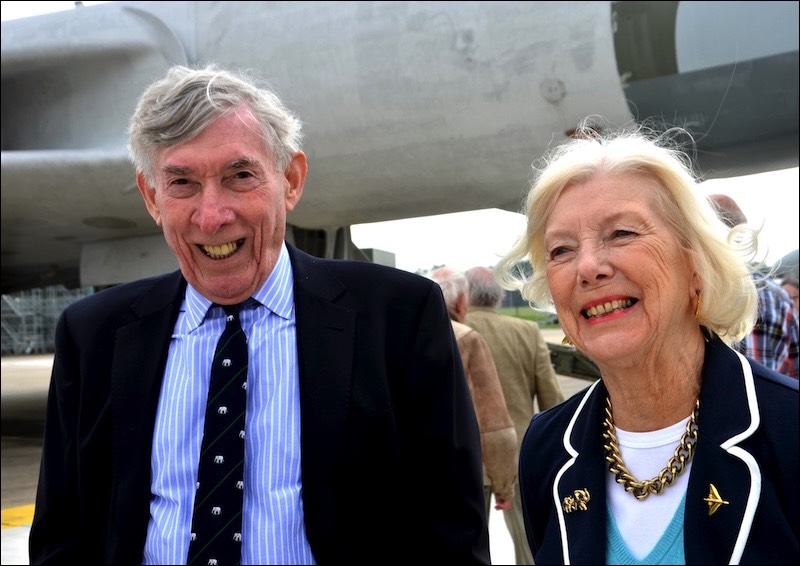
Simon and Sheila Baldwin at RAF Waddington
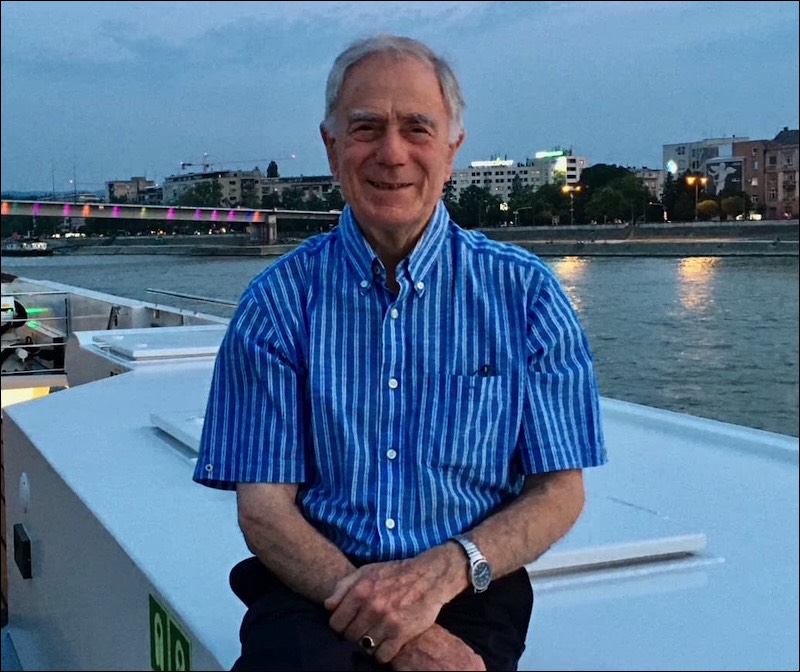
James (Jim) Power
Died 12th February 2026 aged 88 years
James was born in Liverpool in April of 1937 and went to St Mary’s College in Cosby where he was a member of the combined cadet force.
Upon leaving college he joined the RAF, enlisting in February of 1955. He carried out training at No.1 Air Signaller School at Swanton Morley on a mixture of Percival Prentices and Avro Ansons.
Having qualified as an Air Signaller in March of 1956, Jim was initially destined for a first tour on Avro Shackletons. As such his next stage of training was with the School of Maritime Reconnaissance at St Mawgan flying on Avro Lancasters (incidentally, the school was the last unit to use Lancasters and Jim was among some of the last to train on them before they were retired from the RAF in October that year). OCU training on Shackletons followed with 236 at Kinloss.
His first posting was to RAF Aldergrove on December of 1956. However, he never flew on Shackletons operationally. Instead, whilst at Aldergrove he volunteered to transfer to 202 Sqn (Coastal Command), which carried out Weather Reconnaissance flights with the Hastings.
Having completed his time at Aldergrove in Feburary of 1961, Jim then went through 242 OCU at Dishforth followed by qualifying as an Air Dispatcher at the Parachute Training School, Abingdon.
Jim then joined 48 Sqn at RAF Changi, Singapore, in October of 1961. During Jim’s time with 48, the Squadron had a permanent commitment to provide a detachment of two aircraft and crews at Christmas Island. From there they would fly in personnel, foodstuffs, equipment and mail from Honolulu in support of the American Nuclear Tests (Op Dominic). Jim had four such detachments to Christmas Island.
Jim received a Brunei General Service medal with clasp and a Borneo General Service with clasp, whilst on 48 Squadron.
Continuing to fly on Hastings, Jim moved to 24 Squadron at Colerne from June 1964 to June 1966. During which time he was promoted to the Flight Sergeant.
In September of 1966, Jim gained a Direct entry Commission at Henlow as a Fg Off General Duties branch to become an Air Electronics Officer.
His first posting on Vulcans was with 12 Squadron at Cottesmore from February to December 1967.
He then transferred to 35 Squadron, initially at Cottesmore from January 1968 to January 1969 and then Akrotiri from January 1969 to July 1970.
A posting to 44 Squadron at Waddington followed in October 1970 until September 1972. It was during his time on 44 Squadron that, for the first (and only) time in his RAF career, Jim had to abandon an aircraft, namely Vulcan XM610. The aircraft had suffered an engine failure and subsequent fire. Thankfully both he and the rest of his crew (Bob Alcock, Peter Hoskins, Rodger Barker and Jim Vinales) all successfully parted company with XM610 and have remained firm friends, staying in contact ever since.
Jim next moved to 101 Squadron also at Waddington, from September 1972 until May 1973. It was during this posting that Jim married Joy in March 1973.
Jim’s final posting was with 50 Squadron, Waddington, from July 1973 until March 1975. Jim retired from the RAF in April of 1975 (on his birthday!) having completed 20 years of service. After retiring he settled in Lincoln with Joy.
He became the Lincolnshire district retail manager for the charity Oxfam. Which included a detachment to Zimbabwe to observe how the funds Oxfam raised were being utilised and to provide assistance with these projects.
After retiring from Oxfam Jim enjoyed numerous holidays with Joy, revisiting many of the places he’d been to during his RAF career (including Christmas Island!).
Jim was also involved with the 44 Squadron Committee and assisted by organising hotel accommodation and coach transport for reunion weekends. Sadly, this role was short-lived due to Jim’s deteriorating memory.
In 2024, Jim received the Nuclear Test Medal in recognition of his contribution to Britain’s Nuclear test program. His family presented him with his medal at IWM Duxford in front of the Hastings aircraft on display there.
Jim would often reminisce with a smile about how much he enjoyed his RAF career and how lucky he’d been to see so much of the world during his time with the RAF.
Jim is survived by his wife Joyce, son Alexander, daughter Catherine, son-in-law Nicolas and his grandchildren.
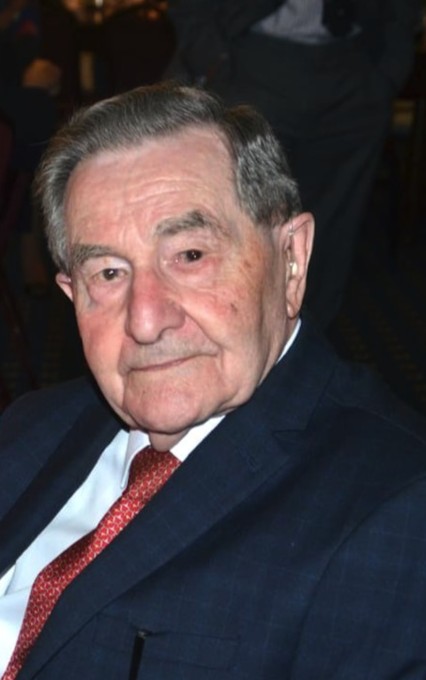
John Jenkins
12.11.1929 - 14.04.2026
We are saddened to inform the passing of Air Gunner Sgt John Jenkins (Chick). He was immensely proud of his service with 44 (Rhodesia) Squadron, albeit for a short period 11th June 1951 to 4th July 1953. He left the service when Mary, his wife of over 63 years, accepted his proposal.
John and Mary attended many reunions together and latterly with his daughter Beverley and her husband. His last reunion was in 2025; he especially enjoyed visiting the RAF College at Cranwell.
Simon Youdan