Display Flying My Favourite Bird
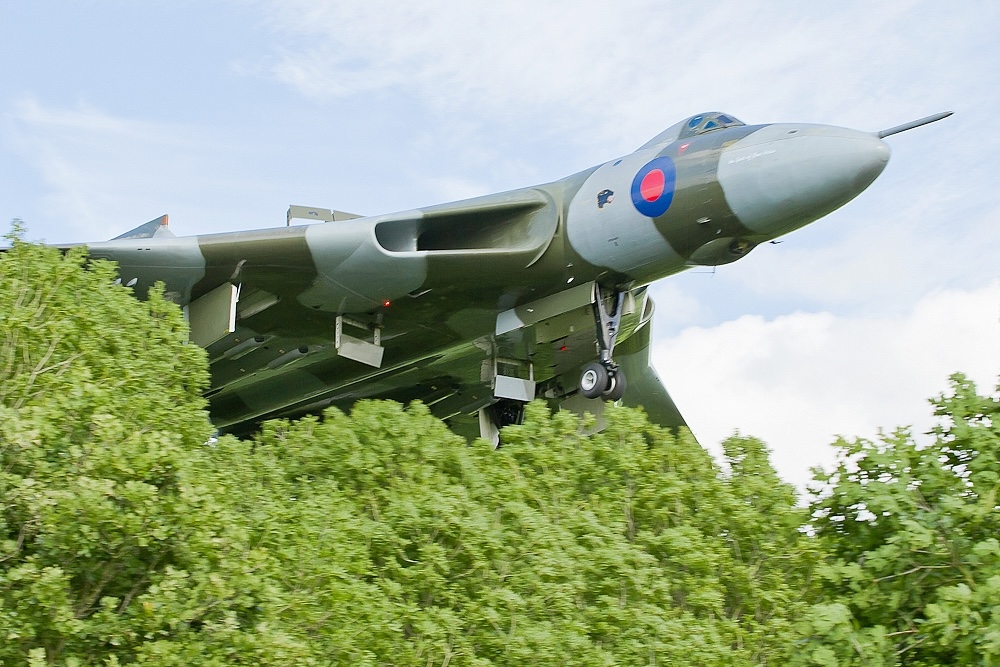
I was a reluctant QFI on 230 OCU the Vulcan training Sqn at Scampton. I say reluctant as the flying was more akin to airlines without a personal crew. However l relieved the pain by offering to accompany Dave Thomas on his display sorties. The OCU also taught me how to really fly the Vulcan as we had to teach minimum asymmetric flying speed to each student. So at the end of my OCU tour l was versed in the airshow scene and confident in flying the Vulcan at low speed.
Having looked at the 'competition', ie, Lightnings, Harriers, Phantoms Gnats (sometimes hordes of red ones) l decided the only way l could compete was to be low, slow and extremely noisy. The slower you flew, the more power you used at the back of the drag curve.
If taking off to start display add 10 knots to rotate speed, apply full aft stick, boot full of rudder and full aileron resulted in spirited start to display. If arriving airborne l requested to arrive over the shoulder of the crowd at 125 knots in a quiet slight bank before full power into the first wingover at 1500ft and maybe down to 90 knots.
The rest of the display of turns and wing overs etc, was flown at 145 knots. I then thought that if l went into a spiral climb at 125 knots at full power it would give the crowd the full Vulcan roar for two minutes in the climb to 2000ft followed by an accelerated run to 350 knots along the display line culminating in a gradual climb to end at 10,000ft nearly vertical at 100 knots. More rudder and aileron to sort it out for descent to land with parachute fully deployed before touch down. I could never understand why my fatigue count was lower than others until l discovered the fatigue meter only activated above 149 knots.
Was this display effective? Who am l to judge, but a prized possession is the Shell Trophy presented to me by Douglas Bader at the IAT Greenham Common for the best aerobatic display. In a Vulcan?!!!
Jon Tye